

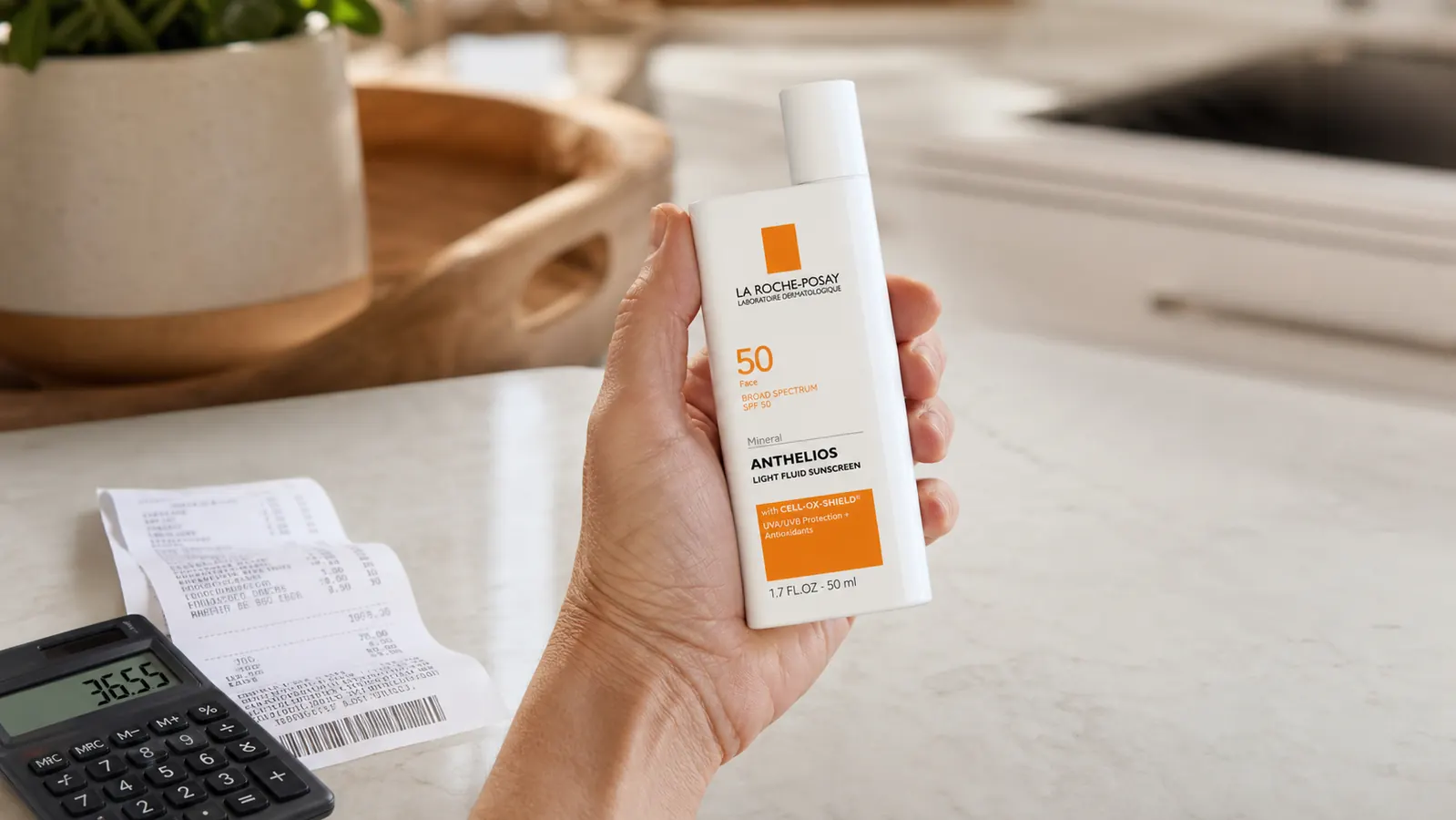
The morning I sat down and actually did the math on my sunscreen spending, I almost put the bottle back on the drugstore shelf. I'd been using La Roche-Posay Anthelios 50 Mineral Tinted Ultra Light Sunscreen Fluid for about six weeks at that point, refilling my makeup bag every few days from the same slim bottle by my bathroom sink, and I had a vague, uneasy sense that I was spending more on sunscreen than I ever had in my life. So I started a notebook. Every bottle I bought, every receipt, every refill, written down with a date next to it. I'm 53, I work from home most days at a desk by a window, and I have combination skin that gets shiny in the T-zone but flaky at the jaw if a product is too drying. I am also, by nature, someone who checks the unit price on the shelf tag before putting anything expensive in the cart, which is exactly why this review exists.
This isn't a review about whether the formula feels nice or blends well, though I'll touch on that. This is a review about the number on the price tag and whether it holds up once you actually track what you're spending over weeks, not just what you feel when you glance at the shelf. If you've ever stood in the sunscreen aisle wondering whether the premium bottle is worth twice or three times what the drugstore version costs, this is the math I did so you don't have to guess.
The Quick Verdict
The price is genuinely high on a cost-per-day basis, roughly eight times what a basic drugstore lotion runs, but the gap closes once you account for what I stopped buying to fix my skin's reaction to cheaper formulas. Worth it for reactive skin, a harder sell if your skin tolerates anything.
Amazon Check Today's Price →Before You Assume the Price Tag Is Just Marketing
I did the actual cost-per-day math on the La Roche-Posay bottle against two cheaper alternatives, and the answer surprised me. See today's price and decide for yourself once you know the real numbers.
Amazon Check Today's Price on Amazon →How I Tracked the Price Question
My method was simple and not scientific in any lab sense, just consistent. Every time I bought a bottle of anything I was using on my face for sun protection, whether it was this one or a cheaper alternative I was testing alongside it on my hands and forearms, I wrote the date, the price, and the size in a small spiral notebook. After ten weeks I had enough data to divide total dollars spent by total days of use, which is the only honest way to compare a $38 bottle against an $11 bottle. Looking at sticker price alone tells you almost nothing, because a cheap bottle you go through twice as fast isn't actually cheaper.
During that same ten weeks I also tracked how much product I was actually using per application, because that number matters as much as the price on the shelf. I use about a quarter teaspoon on my face and neck each morning, which is close to what most dermatologists recommend for real SPF coverage, not the thin swipe most of us grew up applying. At that rate, a single 1.7 fluid ounce bottle lasts me right around thirty days of daily use. That number is the entire foundation of the math below, and it's worth confirming for your own face, because a smaller or larger amount used per day changes everything downstream.
I also want to be upfront that I'm one person with one face, not a lab, and my results are anecdotal. But the arithmetic itself, dollars spent divided by days it lasted, isn't opinion. It's just division. I even had my husband Gary check my numbers one evening at the kitchen table, mostly because he's the one who raised an eyebrow at the receipts in the first place, and he agreed the math held up even after he tried to poke holes in it.
What You're Actually Paying For
The active ingredients here are mineral filters, zinc oxide and titanium dioxide, rather than the chemical filters like avobenzone that show up in most budget sunscreens. Mineral filters have historically cost more to manufacture into a formula that doesn't feel chalky or leave a white cast, and that R&D shows up in the price. It's also fragrance-free and formulated specifically to be gentle on reactive skin, which is a narrower and more expensive formulation target than a mass-market lotion aimed at any skin type.
None of that is a guess on my part, it's just what separates a mineral tinted fluid like this one from an $11 bottle of drugstore SPF 30. The cheaper lotion is doing a simpler job for a broader audience. This one is doing a more specific job, filtering UV rays with minerals instead of chemicals, adding a light tint, and staying thin enough to sit under makeup, for a narrower group of people whose skin doesn't tolerate the cheaper option well. Whether that narrower job is worth the price gap depends entirely on whether your skin is part of that narrower group, which I'll get into further down.
I'll also say plainly that a sunscreen's price has nothing to do with how well it protects you beyond the SPF number on the label. A $38 bottle and an $11 bottle, both labeled broad spectrum SPF 50 and applied correctly at the right amount, are making the same core claim under FDA rules, that used as directed they help prevent sunburn, and when used regularly with other sun protection measures like seeking shade and wearing protective clothing, they can help decrease the risk of skin cancer and early skin aging caused by the sun. Price buys you formula and feel, not a stronger version of that claim.
The Real Cost-Per-Day Math
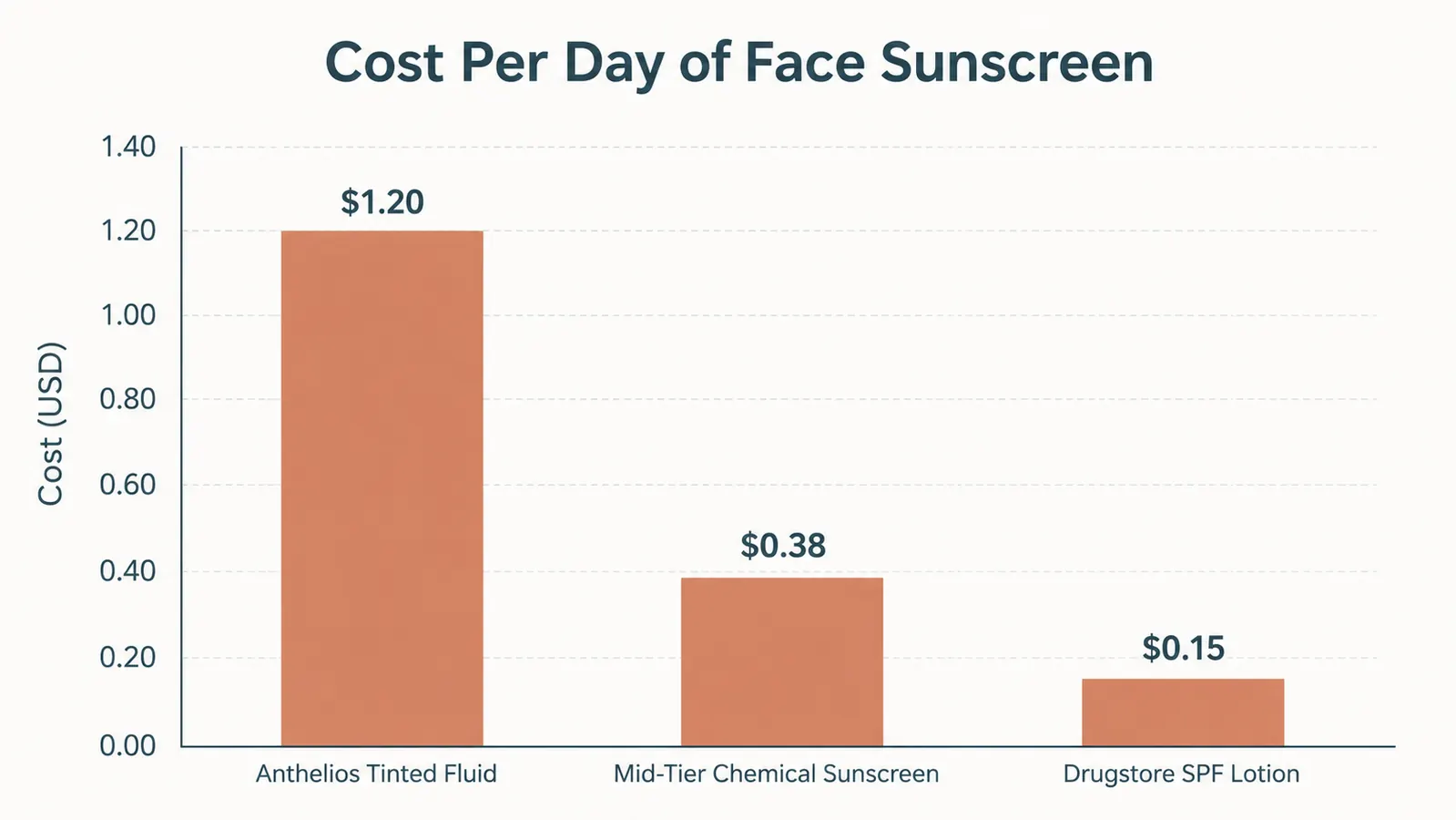
Here's where the notebook paid off. Averaging what I spent across two bottle purchases during the tracking window, this sunscreen runs close to $1.20 a day at the application rate I actually use, roughly a bottle every thirty days. That's the number that made me sit up straight the first time I calculated it, because I'd been thinking of it as a $38 purchase every month or so, not as a line item costing more per day than my morning coffee.
For comparison, I ran the same math on a mid-tier chemical sunscreen I'd used in past years, roughly $16 for a bottle that lasted about six weeks at the same application rate, which comes out to about $0.38 a day. A basic drugstore SPF lotion, the kind sold in a big pump bottle for around $9 and stretched further because the formula spreads thin, worked out to roughly $0.15 a day in my notebook. Lined up next to each other, this bottle costs about eight times what the cheapest option costs per day of use, and about three times what the mid-tier chemical option costs. Those are the real numbers, not rounded in the product's favor.
I'm not going to pretend that gap is small, because it isn't. Stretched out across a full year of daily use, that difference between the cheapest option and this one adds up to real money, well over a few hundred dollars, and I think anyone weighing this purchase deserves to see that number stated plainly instead of buried under a single bottle's sticker price. What changes the calculation for me isn't the La Roche-Posay math in isolation, it's what happened on my skin during the years I used those cheaper options, which is the next part of this.
The Cheaper Sunscreens I Tried First
Before this bottle became a fixture in my bathroom, I went through a string of budget and mid-range sunscreens looking for one that wouldn't leave my T-zone shiny by 10am or my jawline flaking by afternoon. The $9 drugstore lotion, the cheapest option in my notebook, left a faint gray cast along my hairline that no amount of blending fixed, and it made my combination skin noticeably oilier through the middle of the day, enough that I stopped wearing it under makeup entirely. The $16 mid-tier chemical sunscreen was better on texture but caused a mild stinging around my eyes twice, not every day, just often enough that I started avoiding the eye area entirely, which somewhat defeats the purpose of a facial sunscreen.
Neither of those problems is dangerous or dramatic, and plenty of people use both products with zero issues. But they added a hidden cost that never showed up in my notebook until I thought about it honestly: extra blotting papers through the day, a separate mattifying primer I bought specifically to counter the shine, and the mental tax of avoiding my own eye area every morning. Once I priced in what I was buying around the cheaper sunscreen to make it tolerable, the real gap between it and this one got noticeably smaller than the raw cost-per-day numbers suggest. I laid out a fuller side-by-side against the other sunscreen most people compare this one to, texture, tint, and cost included, in this Anthelios versus EltaMD comparison if you're weighing two premium options against each other rather than a premium against a drugstore pick.
Where the Price Genuinely Falls Short
I want to be fair here, because a review that talks itself into justifying a price isn't an honest one. If your skin has never reacted to a cheap sunscreen, if you've worn the $9 drugstore lotion for years without shine, flaking, or stinging, then the extra dollar a day genuinely isn't buying you anything you need. You'd be paying for a formulation problem you don't have. That's a real and common case, and I'd tell a friend in that position to save the money.
The other honest weak point is portion control. The cost-per-day math above assumes you're applying a full quarter teaspoon, which is what actually delivers close to the labeled SPF. It is very easy, especially with a bottle this expensive, to start unconsciously rationing it, using a thinner layer than you should to make the bottle stretch further. I caught myself doing exactly that in week four of my ten weeks, applying a noticeably smaller amount than I had in week one, and I had to correct myself. A sunscreen you're subconsciously underapplying because it costs more isn't actually protecting you at its labeled number, no matter what the bottle promises.
There's also a household math problem worth naming. My mother-in-law, who saw the La Roche-Posay bottle on my counter and asked what it cost, was genuinely taken aback and said flatly that she'd never spend that on a sunscreen for herself. She's not wrong to feel that way. If you're buying for a whole family rather than one face, the per-person cost multiplies fast, and it's worth deciding upfront whether the premium version is only for the person or people in the household whose skin actually needs it, rather than a blanket swap for everyone.
What I Liked
- Mineral zinc oxide and titanium dioxide formula that didn't cause shine or flaking on my combination skin across ten tracked weeks
- Cost-per-day math, while high, is lower than it first appears once you account for extras a cheaper sunscreen forced me to buy
- Tint blends into fair-to-medium skin without the gray cast the drugstore lotion left on me
- Fragrance-free with no eye-area stinging, unlike the mid-tier chemical option I tracked alongside it
- One bottle reliably lasts about thirty days at a correct, full application amount
Where It Falls Short
- Roughly eight times the cost per day of a basic drugstore SPF lotion, a real and significant gap
- Easy to unconsciously underapply once you're aware of the price, which quietly lowers your actual protection
- Only comes in one tint shade, so the value math changes if you need a second product to color-match
- Not a meaningfully stronger sunscreen than a cheap one at the same SPF number, the FDA claim is identical either way
- The savings only show up if your skin actually reacts poorly to cheaper formulas in the first place
The price gap is real, about eight times more per day than the cheapest option in my notebook. What closed that gap wasn't the sunscreen, it was adding up everything I quietly bought to make the cheap version tolerable.

Who This Is For
This makes the most financial sense for anyone whose skin has actually reacted to cheaper sunscreens before, whether that's shine, flaking, stinging, or a gray cast that never blends out. If you've been quietly buying extra products to fix what a budget sunscreen does to your face, the honest cost comparison is closer than the shelf price makes it look. It's also a reasonable pick if you're layering sunscreen under makeup daily and want a thin formula that doesn't pill or ball up, since that convenience has real value even setting price aside. If sensitive or reactive skin is part of your situation, there's more detail on why mineral filters specifically tend to help in this longer story about switching to a mineral formula.
Who Should Skip It
If a $9 or $11 sunscreen has genuinely never bothered your skin, save the money and buy that one, because the premium price here isn't solving a problem you have. If you're on a tight monthly budget and reapply sunscreen liberally throughout the day rather than once each morning, the cost-per-day gap will compound faster than it did in my notebook, since I was only tracking a single morning application. And if you're dealing with a diagnosed skin condition or existing sun sensitivity, talk to a dermatologist before choosing any sunscreen based on price alone. This product is sun protection within the narrow claim on its label, not a treatment for any skin condition, and no amount of spending changes that.
Ten Weeks of Notebook Math Later, I'm Still Buying It
The La Roche-Posay price is real and I didn't round it down anywhere in this review. See today's price and run your own numbers before you decide either way.
Amazon Check Today's Price on Amazon →